


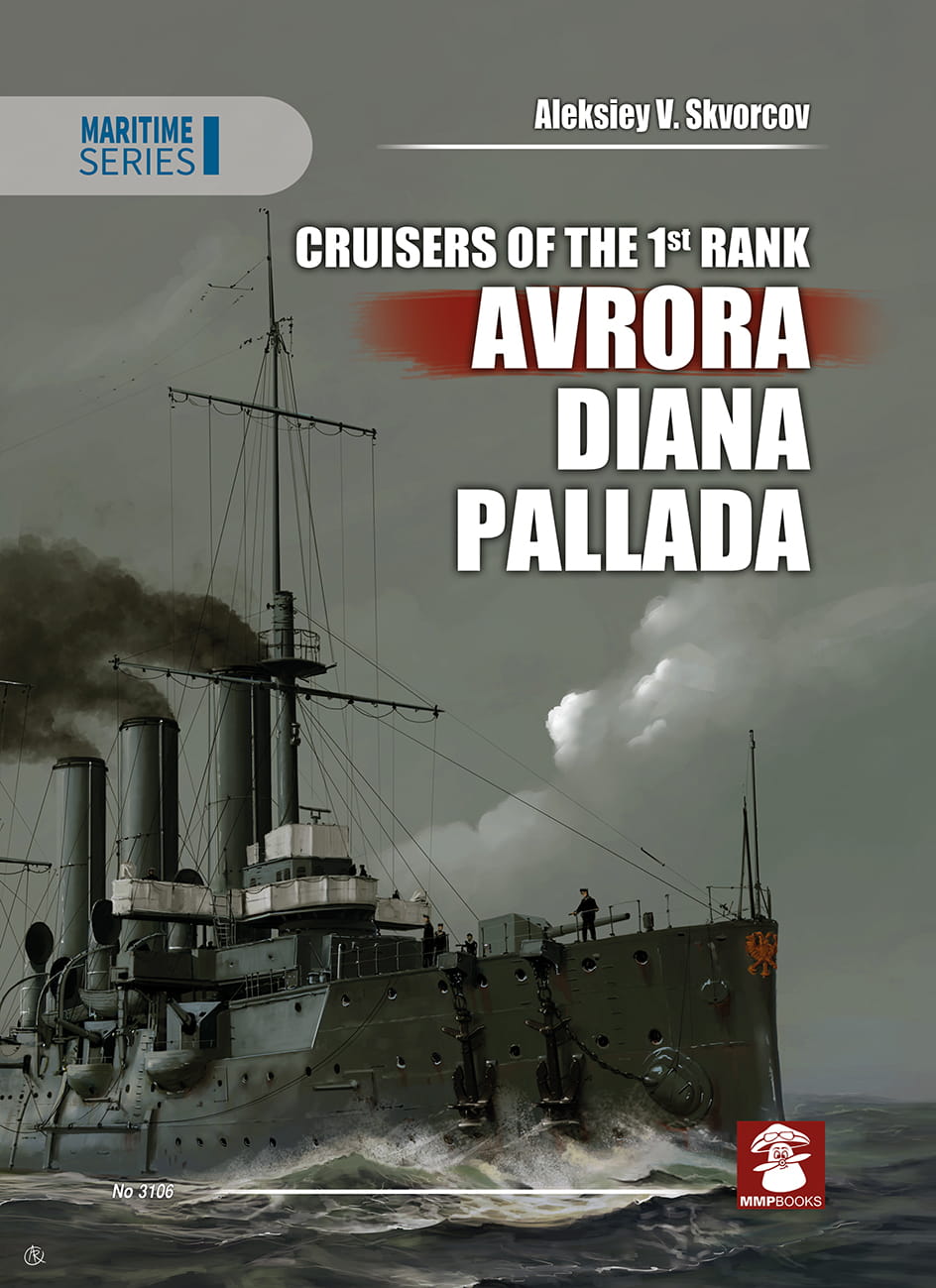
Cruisers of the 1st Rank. Avrora, Diana, Pallada
Shipping costs are not included in the price.
Shipping costs are not included in the price.
ISBN: 9788363678562
Product code: 3106
Info
Aleksiey V. Skvorcov provides great insight into the problems, both technical and political, in the construction and launching of all three ships and their subsequent acceptance trials. The next sixty-one pages are devoted to a rather detailed analysis of the ship’s structure, engines, weapons, and other equipment liberally supported with drawings and photos. The rest of the book describes the service and development of all three vessels.
Pallada, along with Diana, sailed from Kronstadt in October 1902 to join the First Pacific Squadron at Port Arthur. Their first mission was fraught with excessive coal consumption and equipment breakdowns, slowing the other ships in the detachment. The Aurora didn’t fare much better as she left Kronstadt on September 25, 1903 to reinforce the Pacific Fleet.
Both the Pallada and Diana participated in the War with Japan as they played Russian roulette with the Japanese destroyers, described in great detail by Aleksiey V. Skvorcov. The Pallada was eventually hit by a torpedo and limped back to Port Arthur where she remained until captured by the Japanese. The Japanese repaired her and she served as a Japanese training ship and mine layer for ten years as the Tsugaru. The ex-Pallada was finally sunk by Japanese aircraft on the 19th anniversary of the Battle of Tsushima as a celebration of victory.
The Diana suffered damage during the Battle of the Yellow Sea on July 28, 1904, when a shell hit the starboard quarter underwater. The Diana managed temporary repairs and made it to Saigon for more substantial repairs but did not leave Saigon till after the Russia – Japan peace treaty of 1905. Diana eventually returned to the Baltic where she faced a long series of repairs and design changes amidst artillery training detachments. Diana saw action in WWI in the Battle of the Gulf of Riga before joining the February Revolution. Diana served as a hospital ship and moved from Helsinki to Kronstadt where she was moored and disarmed. Diana’s end came in 1922 where she was towed to Germany and scrapped.
Aurora, like her sister ships, suffered equipment breakdowns. The outbreak of the War with Japan saw her detached and sent back to the Baltic where she was refitted. Sent back to the Far East, Aurora suffered from friendly fire, known as the Dogger Bank incident. Aurora finally saw some real action in 1905 in the Battle of Tushima where she lost her captain. Along with two other cruisers, she headed to Manila, then neutral, where she was held by the US until the end of the war. Returning to the Baltic, Aurora became a training ship until the outbreak of WWI. When the February Revolution broke out, Aurora was in St. Petersberg. Aurora fired the first shot on the Winter Palace to start the October Revolution. Aurora returned to the Baltic as a training ship till the outbreak of WWII. Docked at Oranienbaum, Aurora’s guns were removed for the defense of Leningrad (St. Petersberg). Aurora served well as a target until she was finally sunk in late 1941 in her harbor. Aurora was subsequently raised to become a monument in St. Petersberg where she remains today as a museum ship.
Additional info
- Language English
- Author Aleksiey V. Skvorcov
- Illustrator Aleksiey V. Skvorcov
- Date 2016-07-24
- Format A4, HB
- Pages 220
Rating
If you've added a review and it doesn't appear on the list, it may be pending moderation.
Leave feedback on the product

